
Ultrasonic technology
Ultrasonic Machining Technology
How ultrasonic vibration helps machine hard and brittle materials, and how the technology is organised from process up to factory.
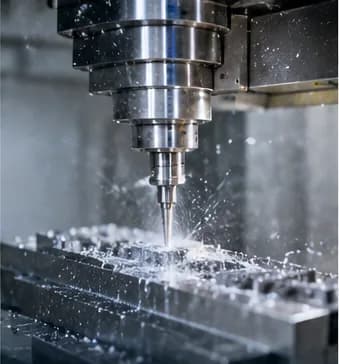
Five layers, from process to factory
A conceptual architecture that shows how the work is organised. It is not a list of released products.
- 01
Layer 01
Physical Process
- Ultrasonic machining
- Precision material removal
- Tool–workpiece interaction
- Difficult-to-machine materials
- 02
Layer 02
Sensing & Data
- Vibration
- Load
- Thermal state
- Spindle state
- Machining result
- Quality signals
- 03
Layer 03
Process Models
- Parameter relationships
- Process windows
- Anomaly patterns
- Repeatable expert knowledge
- 04
Layer 04
Industrial Intelligence
- Diagnosis
- Optimisation
- Prediction
- Scheduling
- Decision support
- 05
Layer 05
Factory Orchestration
- Machine
- Production line
- Quality
- Logistics
- Maintenance
- Plant-level decisions
Ultrasonic precision
Ultrasonic Precision Manufacturing
Leidao ultrasonic technology replaces squeezing force with engraving force.
20,000+
micro-motions per second
Leidao ultrasonic systems apply more than 20,000 high-frequency micro-motions per second to the machining process.
Continuous force
Conventional machining
The tool squeezes the material apart with continuous force. On hard, brittle materials this causes edge chipping, micro-cracks and fast tool wear.
Micro-impact, micro-removal
Leidao ultrasonic machining
Ultrasonic vibration is superimposed on the tool, so the tip engraves material away in high-frequency, small increments.
Effects
- 01High-rigidity ultrasonic machining action
- 02Stress release during material removal
- 03Improved machining efficiency
- 04Reduced internal-crack risk
- 05Reduced tool wear in validated applications
Results depend on material, tooling and process conditions. Measured results for tested applications are on the advanced manufacturing page.

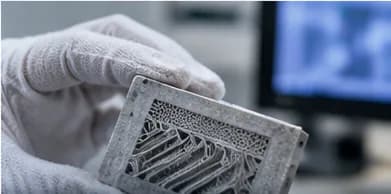
Concept visuals. Not photographs of actual SPETEC or Leidao equipment, facilities, staff or exhibitions.
Materials
Material Technology Matrix
Each material class brings its own manufacturing challenge, and its own process focus.
| Material | Manufacturing challenge | Relevant process focus | Application direction |
|---|---|---|---|
| SiC | Extreme hardness and rapid tool wear | Tool-wear control and precision geometry | Power electronics, semiconductor equipment and high-temperature parts |
| Alumina Ceramics | Hard, brittle ceramic prone to edge chipping | Low-damage removal and tool-wear control | Ceramic chucks, insulators, electronic and wear components |
| Advanced Ceramics | Hardness and brittleness; risk of chipping and subsurface damage | Low-damage material removal and surface integrity | Structural, electronic and wear components |
| Titanium Alloys | Low thermal conductivity, heat build-up and tool wear | Thermal state and tool-wear monitoring | Aerospace, medical and high-performance components |
| High-temperature Alloys | Work hardening, heat resistance and severe tool wear | Process windows and tool-life management | Hot-section parts in energy and aerospace |
| Aluminium Alloys | Tool breakage and chip adhesion in drilling | Tool life in drilling and high-speed cutting | Aerospace and structural components |
| Diamond-related Materials | Extreme hardness and difficult precision geometry | Wafer flatness, low-damage surfaces and thermal geometry | Diamond wafers, cutting tools and thermal-management components |
| Aluminium Nitride | Brittleness and the need for clean surfaces and edges | Surface integrity and dimensional precision | Thermal substrates and heat-spreading parts for electronics |
| CMC | An abrasive fibre–matrix structure prone to delamination | Damage control and surface integrity | High-temperature structures in aerospace and energy |
Challenges and application directions describe each material class. Leidao's measured results are on the advanced manufacturing page.
Machined Components and Materials
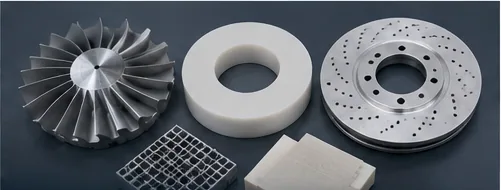
Precision components
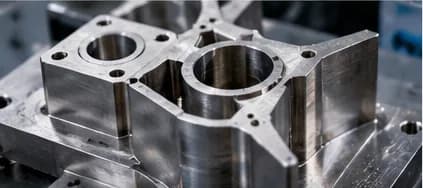
Titanium alloy part
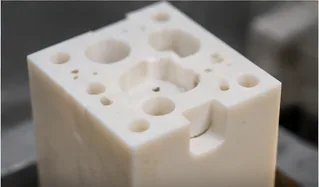
Ceramic block
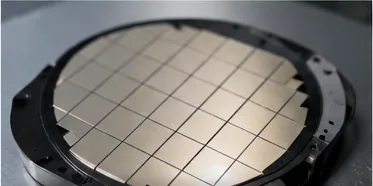
Semiconductor wafer
Concept visuals. Not photographs of actual SPETEC or Leidao equipment, facilities, staff or exhibitions.
The defining story
Beneath AI: Manufacturing and Thermal Management
Above the surface are algorithms, computing and applications. Below the surface are two physical questions.
- 01How is AI hardware manufactured?
- 02How is increasingly concentrated heat removed?
SPETEC and Leidao approach both questions through advanced materials and ultrasonic precision manufacturing.
Manufacturing for the AI infrastructure eraFrom process to decision
From Signal to Industrial Decision
How a signal from the machine could become an industrial decision. This is an illustrative pipeline, not a statement of released capability.
- 01
Machine
The machine tool and its tool–workpiece interaction.
Current - 02
Sensor signals
Vibration, load, thermal and spindle signals.
In development - 03
Feature extraction
Signals reduced to features that describe the process state.
In development - 04
Process model
Features related to parameters, windows and outcomes.
In development - 05
Industrial skill
Proven process knowledge packaged for reuse.
In development - 06
Decision
Diagnosis, optimisation or a recommendation for the engineer.
Roadmap - 07
Machine / line execution
The decision applied to the machine or line.
Roadmap
Machine and signal stages describe the Leidao architecture. The decision and execution stages are roadmap items.
SPETEC does not claim autonomous closed-loop control as a commercial capability.
Industrial skills
Turning Process Know-how into Industrial Skills
A manufacturing skill is a structured package of process knowledge that can be reviewed, reused and improved.
What a skill contains
- Material context
- Tool conditions
- Machine conditions
- Process parameters
- Quality criteria
- Operating constraints
- Expert knowledge
Where this stands
- 01Concept
Concept
The idea of packaging process know-how as a structured, reusable skill.
- 02In development
In development
Skill packages for titanium, high-temperature alloys, ceramics and CMC, built from machine process data.
- 03Roadmap
Roadmap
An Industrial Cloud with a skill library, an API ecosystem and tool and material partner integration. Not yet available.
These tiers describe direction. The skills platform is not yet available.
Research partnerships
Research and Industry Partnerships
Relationships described in the group company profile. Partner names are shown as text only.
A*STAR
A joint laboratory with Singapore's Agency for Science, Technology and Research, on ultrasonic processing of new materials for aerospace, semiconductors and other high-end fields.
National Machine Tool Innovation Institute
A strategic cooperation on key technologies, standards and commercialisation for high-end ultrasonic machine tools.
Sichuan University
Joint development of fractional-order intelligent ultrasonic equipment, on a path from single-machine to line to whole-factory intelligence.
Baoji Machine Tool Group
A strategic cooperation, with the Baoji Leidao ultrasonic machine-tool brand launched jointly.
Let's Engineer What's Next.
Tell us about your manufacturing process, equipment or project, or explore a partnership with the group.